Closing a business is a hard decision, and the last thing you want is a letter from the Departamento de Hacienda (Puerto Rico's Treasury Department, "Hacienda") or your municipality months later about a return you did not file. The key is to understand that each agency has its own closing process and none of them notifies the others for you. This guide gives you the recommended order and the deadlines the law sets.
If you are selling the business instead of closing it, many of these steps apply to you as the seller as well, and the buyer will have to complete their own Registro de Comerciantes (merchant registration).
Before you close: review your situation
- Choose the date you will stop operating. Several deadlines depend on that date.
- Request a Debt Certification and a Filing Certification in SURI (Hacienda's online system). That way you know whether any returns or balances are pending. See Hacienda certifications.
- Make a list of your accounts: state and municipal IVU (sales and use tax), wage and service withholding, income tax, patente municipal (municipal license tax), CRIM (Municipal Revenue Collection Center) and the Labor Department.
- Gather your records. You will need them for the final returns and to keep afterward.
Step 1: IVU and merchant registration
Last monthly return. File the Monthly IVU Return for the last month in which you made sales, no later than the 20th of the following month, and pay the state and municipal IVU. Since July 2026, the municipal IVU for the 73 integrated municipalities is paid through SURI from the Ventas y Uso – Municipal (Sales and Use – Municipal) account. If you had locations in Bayamón, Carolina, Guaynabo, Mayagüez or San Juan, also file and pay the last municipal return with that municipality. The details are in monthly IVU return.
Report the closing within 30 days. Section 4060.01(e) of the Código de Rentas Internas (Internal Revenue Code of Puerto Rico) requires you to notify Hacienda of a total or partial cessation of operations no later than 30 days after it happens. According to Carta Circular (Circular Letter) 26-13, locations are closed from the Ventas y Uso – Estatal (Sales and Use – State) account in SURI. If you close only one of several locations, close that location and keep the others active. Failing to report the change carries a $500 penalty (Section 6043.03(d)).
Watch out for partial payments. If you leave an IVU balance unpaid, it keeps accruing interest and surcharges and shows up on your Debt Certification, even if the business no longer exists.
Step 2: income tax
Final return. The business files its last income tax return for the year it closed, on the normal due dates:
- Corporations: Form 480.2, by the 15th day of the fourth month after the end of their tax year (Section 1061.16). See corporate income tax.
- Pass-through entities: Form 480.2(EC) and Form 480.6EC for each owner, by the last day of the third month after year-end (Section 1061.03). See partnerships and LLCs.
- Individuals with their own business and owners of disregarded entities: the business is reported on your personal return for the year. See how to file your return.
Dissolution notice to Hacienda. Section 1063.05(d) provides that, within 30 days after an entity adopts a resolution or plan of dissolution or of total or partial liquidation, it must give Hacienda a sworn statement with the terms of the plan and the information the regulations require.
Liquidating distributions. If the entity distributes money or property to its shareholders, partners or members when it liquidates, Section 1063.05(e) requires a sworn statement of those distributions no later than February 28 of the following year, with a copy to each owner. Distributions of property are reported at fair market value.
Closing can trigger tax. Selling equipment, inventory or the premises, collecting outstanding accounts or distributing assets to the owners can produce taxable gains for the business or the owners. Plan these transactions with a CPA before you carry them out.
Step 3: if you had employees
- Hacienda: deposit the last wage withholding, file the last quarterly return 499R-1B and prepare the employees' 499R-2/W-2PR withholding statements for the year. The general due date for the W-2PR is January 31 of the following year. For 2025, it was February 2, 2026 (Boletín Informativo 25-08). See employer obligations.
- Contractors: file the informative returns for what you paid them during the year, and deposit any pending 10% withholding. See informative returns 480.
- Labor Department: file the last quarterly unemployment and SINOT (non-occupational disability insurance) return, pay what you owe and report the change in employer status, one of the services the Departamento del Trabajo y Recursos Humanos (DTRH, Puerto Rico's Department of Labor and Human Resources) lists for employers. Since September 2026, this is done on the Desempleo Digital platform.
- IRS: file the last federal payroll returns, such as Form 941, following the IRS instructions for businesses that are closing.
Step 4: the municipality
Final business volume declaration. The official Declaración de Volumen de Negocios form (business volume declaration, OGP PA01) has a Planilla Final (final return) box. File it with the municipality with the information for your last year and pay the license tax that applies. See municipal license tax.
Ask the municipal Finance Department what they need to close your license tax account and, if it applies, your municipal IVU account in the five non-participating municipalities.
Step 5: CRIM
If your business had equipment, furniture or inventory, it probably filed the personal property return (planilla de propiedad mueble) with CRIM. File the last one that applies to you, pay the balance and ask CRIM how to report that you stopped operating. The CRIM portal lets you file the personal property return and get a certification that you filed it. See personal property tax.
Step 6: the State Department
If your business is a corporation or an LLC, closing the tax accounts does not eliminate the entity. The dissolution of a corporation or the cancellation of an LLC is handled at the Registro de Corporaciones (Registry of Corporations) of the Departamento de Estado (Puerto Rico's State Department), under the General Corporations Act (Ley 164-2009, Act 164-2009). As long as the entity remains registered, it may still have obligations, such as annual reports. An attorney can help you with the dissolution documents.
Step 7: keep your records
Section 4060.06 requires you to keep evidence of sales and IVU in Puerto Rico for no less than six years. Also keep your returns, payroll records, informative returns and closing documents. If Hacienda audits you after you close, those documents are your defense.
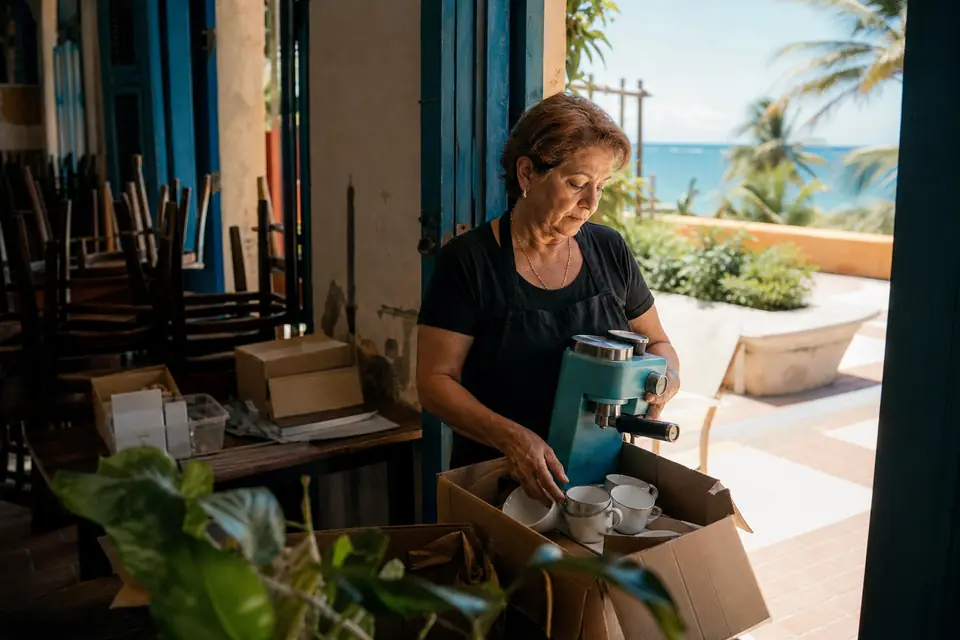
Carmen closes her café in Rincón, an LLC taxed as a pass-through entity, on October 31, 2026. A possible timeline:
- November 20, 2026: she files and pays the October IVU return and reports the closing of the business and its location in SURI, within the 30 days.
- November 2026: the members adopt the plan of dissolution, and the LLC gives Hacienda the sworn statement within 30 days.
- January 31, 2027 (or the next business day): the fourth-quarter 499R-1B return and the W-2PR forms for her two employees.
- February 28, 2027 (or the next business day): the contractor informative returns and the statement of liquidating distributions.
- Final Form 480.2(EC) and the members' Forms 480.6EC: the last day of the third month after the LLC's last tax year ends. If that year ends December 31, 2026, they are due March 31, 2027. If it ends earlier because of the liquidation, they are due earlier. Her accountant determines the date.
- April 2027: the final business volume declaration with the municipality.
Frequently asked questions
Is it enough to stop filing returns to close the business?
No. If you do not report the closing, Hacienda keeps expecting your monthly IVU returns and can impose penalties for not filing them. Report the closing in SURI within 30 days and file the final returns.
When do I file the last income tax return if I closed mid-year?
On the normal due dates for your type of entity, unless your tax year ends earlier because of the closing. If you use a calendar year, a corporation's final return is due April 15 of the following year, and a pass-through entity's is due March 31.
What happens to the debts the business leaves behind?
They do not disappear when you close. Debts for collected IVU and for wage withholding are especially sensitive, because the Code can hold the officers responsible for remitting them personally liable. If you cannot pay it all, see payment plans with Hacienda.
Do I have to notify the municipality even if I do not owe license tax?
Yes. It is a good idea to file the final business volume declaration and ask them to close your account. That way the municipality does not keep sending you notices or assessing license tax for years when you were no longer operating.
Do I need an attorney to close?
For a small sole proprietorship, many people do it with their accountant. If it is a corporation or LLC, or if there are partners, employees, debts or a sale of assets, it is a good idea to have an attorney and a CPA help you with the dissolution and the final returns.
Sources
- Código de Rentas Internas de Puerto Rico de 2011, según enmendado (Secciones 4060.01, 4060.06, 1061.03, 1061.16 y 1063.05), Departamento de Hacienda. hacienda.pr.gov
- Departamento de Hacienda, "Carta Circular de Rentas Internas Núm. 26-13 (integración del IVU municipal en SURI)", 30 de junio de 2026. hacienda.pr.gov
- Departamento de Hacienda, "Boletín Informativo de Rentas Internas Núm. 25-08 (comprobantes de retención y declaraciones informativas para el año 2025)". hacienda.pr.gov
- Departamento del Trabajo y Recursos Humanos, "Servicio Contributivo". trabajo.pr.gov
- Oficina de Gerencia y Presupuesto, "Declaración de Volumen de Negocios, formulario OGP PA01 (rev. febrero 2025)". guaynabocity.gov.pr
- Centro de Recaudación de Ingresos Municipales (CRIM), "Servicios en línea". crimpr.net
787TAX is an independent guide. It is not Puerto Rico's Departamento de Hacienda, the CRIM or the IRS. This page is general information, not tax or legal advice. Example figures are hypothetical. Found an error? Tell us.