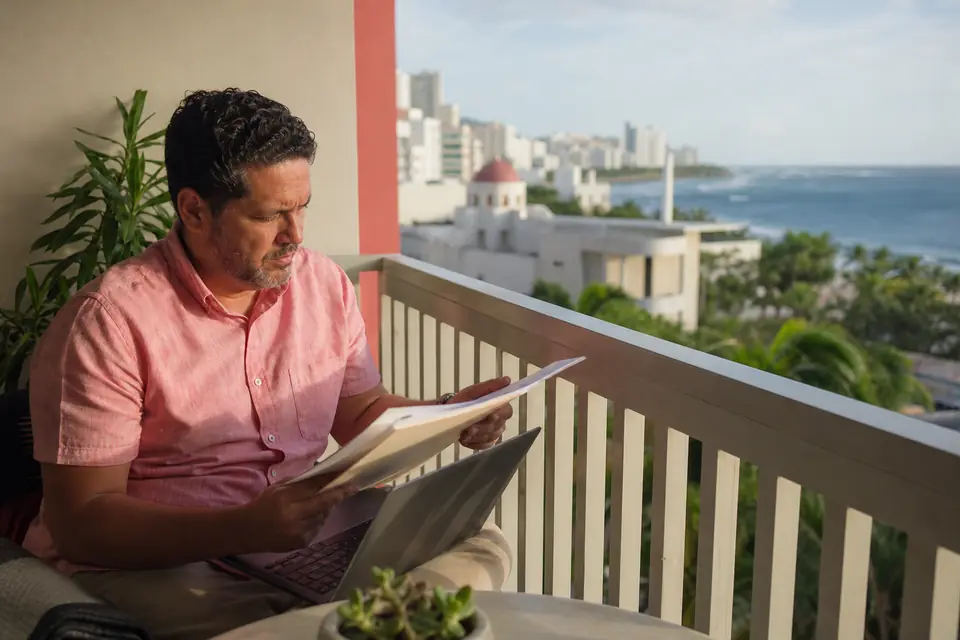
Moving to Puerto Rico does not take you out of the U.S. tax system, and it adds a second one. As a U.S. citizen living on the island, you may owe nothing to the IRS on your local income, but only if you meet strict residency rules. Meanwhile, Puerto Rico's own Treasury Department, the Departamento de Hacienda, expects a return from you as a resident.
This guide walks through both sides, in the order most people need them. It uses IRS publications for tax year 2025 and Puerto Rico's official laws and instructions. It is general information, not advice for your situation.
Two tax systems, one move
The IRS. Puerto Rico residents who are U.S. citizens are still U.S. taxpayers. The difference is that income from Puerto Rico sources earned by a bona fide resident is excluded from federal income tax under IRC Section 933. Income from U.S. or foreign sources remains taxable by the IRS. Federal Social Security and Medicare taxes still apply.
Hacienda. Puerto Rico has its own income tax code, the Código de Rentas Internas de 2011. You file an annual Puerto Rico return and pay at Puerto Rico rates.
Your old state. Leaving a state does not always end its claim on you. Each state has its own rules for when you stop being a resident. Check with your state's tax agency or a tax professional there.
Becoming a bona fide resident for the IRS
Under IRC Section 937, explained in IRS Publication 570, you are a bona fide resident of Puerto Rico for a tax year only if you pass all three of these tests.
1. The presence test
You pass if you meet any one of these for the tax year:
- at least 183 days in Puerto Rico;
- at least 549 days in Puerto Rico over the current year and the two prior years, with at least 60 days in each of those years;
- no more than 90 days in the United States;
- no more than $3,000 of U.S.-source earned income, and more days in Puerto Rico than in the United States;
- no significant connection to the United States during the year, such as a permanent home there.
2. The tax home test
Your tax home, generally your regular or main place of business or work, must not be outside Puerto Rico during the year.
3. The closer connection test
You must not have a closer connection to the United States or a foreign country than to Puerto Rico. The IRS compares where your permanent home, family, belongings, bank accounts, driver's license, voter registration and social and religious ties are. Publication 570 gives the example of someone who moved to Puerto Rico but kept a family home, banking and voter registration in California, and was not a bona fide resident.
The year you move
You may not meet the tax home and closer connection tests for the whole year of the move. Publication 570 lets you meet them in that year if:
- you were not a bona fide resident of Puerto Rico in any of the 3 tax years before the move;
- during each of the last 183 days of the year, you had no tax home outside Puerto Rico and no closer connection elsewhere; and
- you are a bona fide resident for each of the 3 tax years after the move.
You still need to pass the presence test for that year.
Hypothetical example. Jordan moves from Florida to Puerto Rico on July 1, 2026, takes a job with a local company and does not return to the mainland that year.
- Days in Puerto Rico from July 1 through December 31, 2026: 184, so Jordan passes the 183-day presence test.
- Jordan was not a resident in 2023, 2024 or 2025 and has no tax home or closer connection outside Puerto Rico in the last 183 days of 2026, so the year-of-move rule can apply, provided Jordan stays a bona fide resident in 2027, 2028 and 2029.
- If Jordan's worldwide gross income for 2026 is more than $75,000, Jordan must also file Form 8898.
Form 8898
File Form 8898 for the tax year in which you become, or stop being, a bona fide resident of Puerto Rico if your worldwide gross income is more than $75,000. Do not count your spouse's income; each spouse who must file sends a separate form. Mail it separately from your return, by the return's due date including extensions. The penalty for not filing is $1,000, unless you show reasonable cause.
What still goes to the IRS
Even as a bona fide resident, you may need to file a federal Form 1040. According to IRS Publication 1321, you generally must file if you have income from sources outside Puerto Rico, or income as a civilian or military employee of the U.S. government, above an adjusted filing threshold. Some points to know:
- Source matters. Wages are sourced where you do the work. Interest is sourced by the payer's residence and dividends by the payer's location, so interest from a U.S. bank or dividends from a U.S. company are generally U.S.-source. Social Security benefits are U.S.-source by definition.
- Federal workers. Pay you receive as a federal employee in Puerto Rico is not excluded.
- Deductions are prorated. Deductions tied to excluded income are not allowed, and the standard deduction is allocated between taxable and excluded income.
- Credits. Bona fide residents cannot claim the federal Earned Income Tax Credit. Special rules apply to the Child Tax Credit.
- Self-employment tax. If you work for yourself, federal self-employment tax still applies, generally on Form 1040-SS.
- Investments you bring with you. If you were a U.S. resident in any of the 10 prior years, gains on certain property you owned before moving are not treated as Puerto Rico-source. See our Resident Individual Investor guide.
Filing with Hacienda
Who is a resident. Under the Puerto Rico Internal Revenue Code, a resident is someone domiciled in Puerto Rico. You are presumed to be a resident if you are present in Puerto Rico for 183 days during the calendar year.
What you report. A Puerto Rico resident reports income from all sources. To limit double taxation, the Code offers a credit for income taxes paid to the United States, its territories, foreign countries or U.S. states, subject to limits (Section 1051.01).
How and when. For tax year 2025, Hacienda required electronic filing through its online system, SURI, or certified software, by April 15, 2026. A timely extension request gives you 6 more months. Our Puerto Rico income tax basics page covers rates and withholding.
The year of the move. Your Hacienda return for that year has questions on residency for the full year and on income from sources outside Puerto Rico. Read the instructions carefully or work with a local preparer.
Sales tax and property tax
IVU. Puerto Rico's sales and use tax, the impuesto sobre ventas y uso (IVU), is generally 11.5%: 10.5% for the state and 1% for the municipality. Some items are exempt. Goods you bring or order from outside Puerto Rico may owe use tax. See doing business in Puerto Rico for how it works for sellers.
Property tax. Real property tax is administered by the CRIM (Centro de Recaudación de Ingresos Municipales). Owners of a home used as a residence get an exemption on the tax that corresponds to up to $15,000 of the property's assessed value, measured in 1957 replacement-cost terms under the Municipal Code (Article 7.035). To get it, you must file a certification with the CRIM, or with your mortgage lender if you have one, as the CRIM provides. Our guides explain property tax and the principal residence exemption.
Should you look at Act 60?
Puerto Rico's Incentives Code offers decrees for investors and service businesses. They come with costs, obligations and federal limits. Start with our Act 60 guide.
Frequently asked questions
If I work remotely for a U.S. company from Puerto Rico, is my salary excluded?
Wages are generally sourced where you perform the work. If you are a bona fide resident and do the work while physically in Puerto Rico, the pay is generally Puerto Rico-source and excluded under Section 933. Work days spent on the mainland produce U.S.-source pay. Your employer's withholding setup also matters, so talk to a professional.
Do I still pay Social Security tax?
Yes. Puerto Rico residents pay federal Social Security and Medicare taxes on wages, and the self-employed generally owe federal self-employment tax.
Do I file both a federal and a Puerto Rico return in the year I move?
Often, yes. You may have U.S.-source income from before the move, and you will have a Puerto Rico filing obligation as a new resident.
What if I move back to the mainland later?
Leaving Puerto Rico has its own rules, and Form 8898 also applies in the year you stop being a bona fide resident if your worldwide gross income is more than $75,000.
Can I keep my house in another state?
You can, but a home available to you in the United States can weigh against you in the closer connection test and the "no significant connection" presence option. How the IRS weighs it depends on all your facts.
Sources
- IRS, "Publication 570 (2025), Tax Guide for Individuals With Income From U.S. Territories". irs.gov
- IRS, "Publication 1321 (October 2025)". irs.gov
- IRS, "Instructions for Form 8898 (Rev. October 2024)". irs.gov
- Puerto Rico Treasury (Hacienda), "Folleto de Instrucciones, Planilla de Contribución sobre Ingresos de Individuos 2025". hacienda.pr.gov
- Puerto Rico Treasury (Hacienda), "Código de Rentas Internas de Puerto Rico de 2011, as amended". hacienda.pr.gov
- Office of Management and Budget of Puerto Rico (OGP), "Código Municipal de Puerto Rico, Ley 107-2020, as amended". bvirtualogp.pr.gov
787TAX is an independent guide. It is not Puerto Rico's Departamento de Hacienda, the CRIM or the IRS. This page is general information, not tax or legal advice. Example figures are hypothetical. Found an error? Tell us.